Employee turnover is normal in a growing San Jose company, but key control problems shouldn't be. The moment an employee leaves, your physical security posture changes -- keys get copied, spares go missing, and vendors get handed access for quick projects. This checklist covers what to do immediately during offboarding and how to decide between rekeying and full lock replacement.
In fast-moving San Jose workplaces, it's easy to treat keys as minor assets until something goes wrong. The biggest issue usually isn't malicious intent -- it's uncertainty. If you can't confidently answer who currently has keys (including duplicates), which doors those keys open, whether the employee ever took a key home or copied it, or whether vendors and cleaning crews still have the same key, you have a vulnerability. A key control policy only works if it's enforced and updated during every personnel change.
Use this checklist every time someone leaves, especially if they had regular building access or handled sensitive assets.
Start by mapping access, not guessing. Create a quick list covering exterior doors (front, rear, roll-up, shared entrances), interior doors (private offices, server or IT closet, storage), restricted areas (HR files, finance, inventory cages, tool cribs), keys to non-door locks (mailbox, padlocks, cabinets), and alarm codes, key fobs, gate remotes, or parking garage access. If you don't already have a key log, start one now -- even a spreadsheet is better than nothing.
Don't accept "I turned in my key" without verifying. Count returned keys, compare key numbers or stamps if you have them, and ask whether any copies were made and document the answer. If you cannot prove every issued key is returned, assume you have an exposure.
This is the core question -- use the trigger list below to decide.
Even if you rekey, policy prevents the next gap. Update your key assignment records, who is authorized to issue keys, procedures for duplicates and vendor keys, and how lost keys get reported.
Add physical security to your offboarding process: keys returned and verified with counts, key fob or card disabled, alarm codes changed if shared, parking access removed, equipment and badges returned, and the rekeying decision documented (yes or no, and why).
Rekey immediately if any of the following are true:
Owners often delay because nothing bad has happened yet. What can realistically occur includes a former employee returning after hours with an old key (intentional or accidental), theft of inventory, tools, laptops, or documents, liability disputes if an unauthorized person enters and an incident occurs, employee anxiety over who else might have keys, and increased insurance friction after a claim if access control was weak. In other words, the risk is usually less about one dramatic break-in and more about preventable, ongoing exposure.
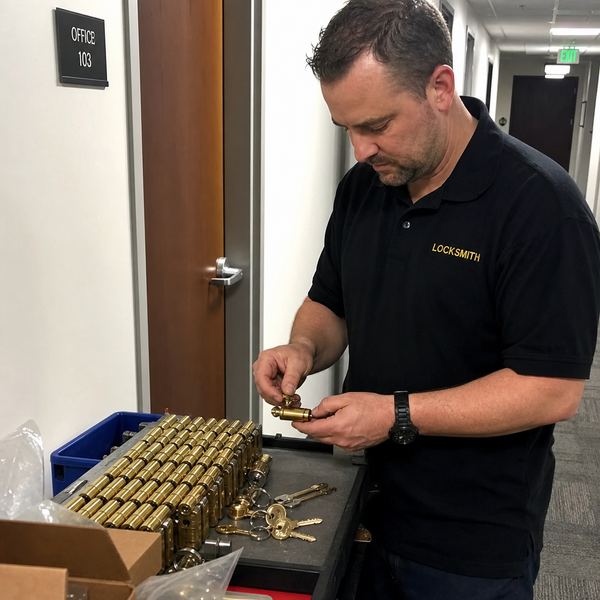
Rekeying changes the lock's internal pins so old keys stop working and new keys are issued. This usually makes sense for standard commercial cylinders in good shape, turnover-driven security resets, and restoring key control without changing door hardware. It's typically faster and less disruptive than replacement.
Lock replacement is the better call when the lock is worn, sticking, or failing, you want higher-security hardware, the existing lock is low-grade or incompatible with restricted keyways, or you're converting to a different lock function. A locksmith can usually help you decide during a walk-through.
Some cylinders are DIY-rekeyable, but many commercial setups -- mortise locks, interchangeable cores, restricted keyways -- are best handled by a licensed locksmith to avoid miskeying, door misalignment, or accidental lockouts.
A professional commercial rekey visit typically covers an on-site evaluation of doors and cylinders, rekeying cylinders and cutting new keys, keying strategy support (same-key versus segmented access), and optional upgrades like restricted keyways or high-security cylinders. Pricing is commonly influenced by the number of cylinders and doors, lock type (standard versus mortise versus high-security), whether it's after-hours or emergency service, key system complexity (master keying, multiple groups), and hardware condition. Keeping a simple door schedule -- door name, lock type, and how many keys are needed -- speeds up quotes and reduces surprises.
Rekeying is straightforward, but it isn't the only approach. If you have frequent turnover or many access points, consider keypads (change a code instead of changing locks), key fob or card systems (disable credentials instantly), smart locks (audit trails, scheduled access), or interchangeable core (IC) systems that let you swap cores quickly without a full rekey. These options can reduce ongoing locksmith calls, but they require good administration -- credential assignment, prompt deactivation, and periodic audits. Many San Jose businesses use a hybrid: keyless entry on the main entrance, mechanical keys for interior rooms, and restricted keyways for high-value areas.
High security isn't just a tougher-looking lock. For office and commercial spaces, the most useful upgrades typically focus on key control and attack resistance: restricted or patented keyways that are harder to copy without authorization, drill-resistant cylinders and reinforced components, professional-grade commercial levers and deadbolts, and door reinforcement like strike plates and frame integrity. If uncontrolled duplicates are your main problem, a restricted key system can matter more than simply buying a heavier lock.
Security doesn't start when someone leaves -- it starts on day one. Add physical access steps to your onboarding process: issue only the access required for the role, have employees sign for keys and acknowledge no unauthorized copies, explain lost-key reporting expectations and timelines, and document which doors their keys open. Treating physical access like any other permission -- granted intentionally and revoked promptly -- keeps turnover from becoming a security surprise.
The goal isn't to rekey every time someone resigns -- it's controlled access, so you can prove who can enter your San Jose business and why. San Jose Locksmith is licensed under California Locksmith License LCO 6739 (BSIS) and open Sunday through Thursday 9 AM to 9 PM and Friday 9 AM to 5 PM (closed Saturday) for commercial rekey and lock service.
When should I rekey my business locks after an employee leaves?
Rekey right away if keys are missing or unaccounted for, if the departure was contentious, if the employee had access to high-value or regulated areas (server rooms, finance records, inventory), or if you use a master key system where one missing key could affect the whole building.
What's the difference between rekeying and replacing a lock?
Rekeying changes the internal pins of an existing lock so old keys stop working and new keys are issued -- it's usually faster and less disruptive when the hardware is in good condition. Replacement is better when the lock is worn, damaged, low-grade, or you want to upgrade to higher-security hardware.
Do I need to rekey every time an employee quits?
Not necessarily. If your key log confirms every issued key was returned and there's no reason to suspect a copy was made, you may be able to skip rekeying. The decision should be based on documented key control, not guesswork.
What should an offboarding security checklist include?
At minimum: verified key returns with counts, disabled key fobs or access cards, changed alarm codes if shared, removed parking access, returned equipment and badges, and a documented rekeying decision (yes or no, and why).
Last updated: August 2026